



This post is all about woodworking jobs. You know, the kind of work that smells like fresh lumber, lets you build things with your hands, and can pay the bills.
That’s right, some of these woodworking jobs can make seriously good money too…
Just try not to do what half the guys in the trade do and immediately spend your entire paycheck on power tools you suddenly “absolutely need” just 5 minutes after getting hired.
Because apparently every new job requires 3 new saws and 1 suspiciously expensive drill.
If you’ve ever stared at a cubicle wall and thought, I should be building tables instead of spreadsheets, you’re definitely not the only one. And honestly? A lot of small woodworking businesses start exactly like that… one project in a garage that slowly turns into real income.
A lot of people daydream about woodworking jobs. You know… working with your hands, building real things, and escaping the whole office-life situation.
And here’s the good news.
Turning woodworking into real income is totally possible.
But there’s one little thing that some beginners don’t realize at first.
Making money with woodworking isn’t just about building really cool stuff. It’s about knowing whatto build and where to sell it.
And that’s exactly where a lot of people get stuck in the beginning.
But before you march into work tomorrow and quit your job in a dramatic blaze of glory… let’s slow down for a second and talk about what actually works in the world of woodworking.
Because the truth is, woodworking can absolutely make money… but it can also lead to stress, debt, and a garage full of half-finished projects if you go about it the wrong way. And nobody needs financial panic sprinkled with a little decorative sawdust.
Even government data shows that skilled carpentry and woodworking trades can pay solid money over time. According to the U.S. Bureau of Labor Statistics, carpentry and related trades continue to be in demand as construction and renovation projects grow.
In other words… people will always need things built. It’s always going to be one of the jobs left that cannot be taken over by AI and robots!
Now here’s another part I really love about woodworking.
This is one of those hustles that doesn’t care if you’re a man or a woman. If you can build something solid, solve a problem, and make customers happy, the money follows.
And listen… I know I talk a lot about being a boss babe around here.
But trust me on this one — man or woman, anyone can step into boss-babe energy.
And a woodworking boss babe?
Honestly… that’s kinda sexy.
Just sayin’. 😉
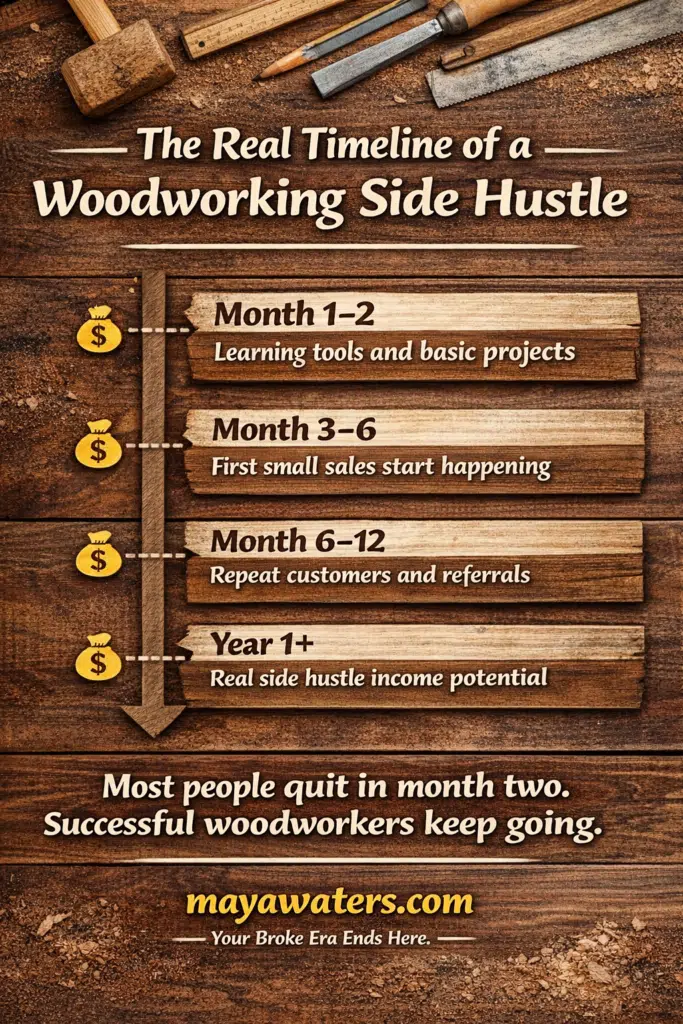
TL; DR: Woodworking Jobs
Short answer?
Yes. Absolutely.
Some woodworking jobs can make very good money. I’m talking real paychecks… not “I sold one birdhouse on Facebook Marketplace and now I’m an entrepreneur” money.
But here’s the boss-babe reality check. Woodworking actually becomes profitable when you:
📌 Start it as a side hustle first
📌 Know your real profit (not “it feels profitable”)
📌 Build consistent clients
📌 And don’t confuse a couple lucky sales with a full-blown business
Woodworking can absolutely become a paycheck.
It can even turn into six-figure income for some people.
But it can’t be three coffee tables and a dream……just sayin’.
⬆️ PIN THIS! ⬆️
Can Woodworking Jobs Make Good Money?
Woodworking jobs can make very good money, especially in areas like custom cabinetry, built-ins, and contractor work. Many woodworkers start woodworking as a side hustle before turning it into a full-time career. The key is building repeat clients, tracking real profit, and focusing on projects with consistent demand.
Examples of woodworking jobs that pay well:
- Custom cabinetry
- Built-in storage projects
- Furniture for contractors or designers
- Repeatable workshop products
- Commercial or bulk woodworking orders
Beginner Woodworking Projects That Actually Sell
Here’s a mistake a lot of new woodworkers make in the beginning.
They build whatever feels fun at the time… and then hope someone will magically want to buy it.
A coffee table here.
A cutting board there.
Maybe a birdhouse that nobody asked for.
And listen, those projects might look great sitting in the workshop.
But that doesn’t always mean they turn into real woodworking jobs that pay money.
Because some woodworking projects are simply easier to sell than others.
The projects that tend to make the best side hustle money usually have these things in common:
📌 They solve a real problem
📌 They’re easy to build again and again
📌 And people buy them over and over
That’s where the money starts showing up.
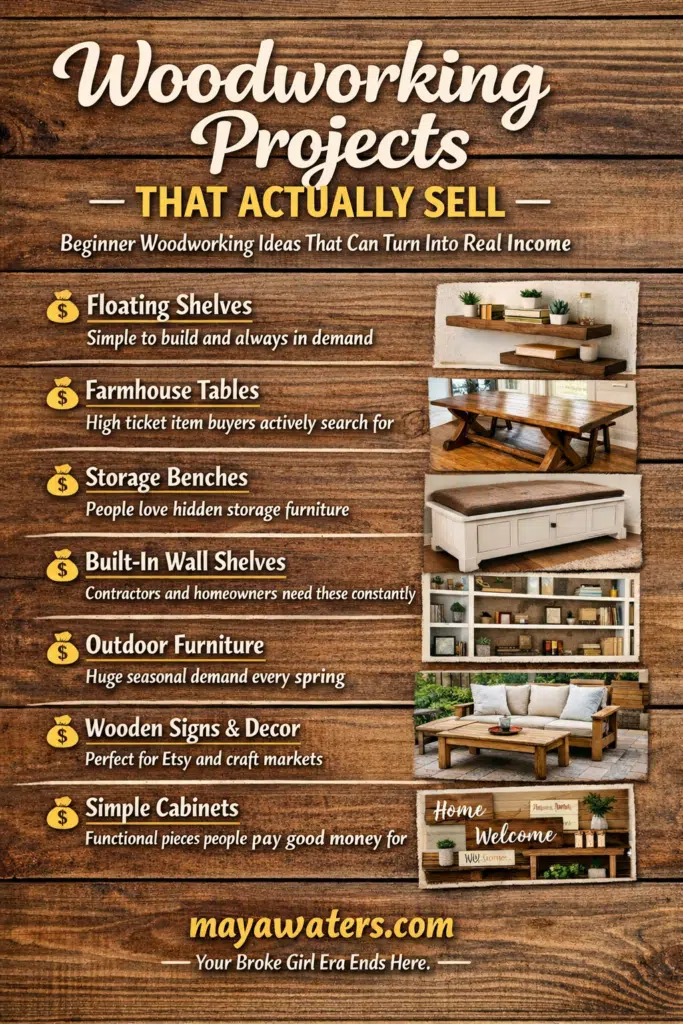
Some beginner woodworking projects that tend to sell well include:
• Floating shelves
• Storage benches
• Farmhouse tables
• Built-in wall shelves
• Wooden signs and home décor
• Outdoor furniture
• Simple cabinets and storage units
See the pattern?
These are things people truly NEED in their homes, not just projects that look cool sitting in a garage.
Because here’s the truth about woodworking jobs.
A project can be beautiful… and still not sell.
And when you’re trying to turn woodworking into a real side hustle, it helps to know which projects already have demand before you start cutting lumber.
That’s one of the reasons a lot of beginners like guides such as WoodProfits. It breaks down the types of woodworking products people are already selling successfully and shows how beginners turn those ideas into real income.
Because building something amazing is great.
But building something people are actually willing to pay for?
That’s when woodworking starts turning into a paycheck.
A Cautionary Tale Everyone Needs to Hear
Back in 2009, I had a friend who had what most people would call a “very solid job”.
📌 Steady paycheque.
📌 Benefits.
📌 Predictable hours.
You know… basic adult stability!
Check. Check. Check.
But on the side, he had a little hobby building furniture in his garage. A couple coffee tables here, and a bench there. He sold a few and made maybe a grand total.
And suddenly he was convinced he was one Etsy shop away from becoming the next woodworking legend.
Now don’t get me wrong. Woodworking jobs can absolutely make money. Some people turn woodworking into full-time careers.
But my friend skipped a very important step called reality.
One day at work, things started going sideways.
His boss noticed he was distracted. Deadlines slipping. More focused on pine planks and table legs than spreadsheets.
So, he gets called into the office and hit with the classic corporate line:
“This job needs your full attention… or you’re done here.”
Now a reasonable person would smile politely, go home, and quietly start planning their escape.
Not this guy. Nope!
He went full boss-battle mode.
He quit. Right there.
💰 No savings plan.
💰 No steady clients.
💰 No backup income.
Just pure confidence… and a garage full of half-finished tables.
He went all-in on woodworking jobs that very afternoon.
And let me tell you something.
That decision aged about as well as milk in July.
Because selling three coffee tables does not magically turn woodworking into a sustainable income.
Who knew, hey!?
⬆️ PIN THIS! ⬆️
Why His Woodworking “Business” Failed So Fast
Let me be very clear here.
His problem wasn’t woodworking.
His problem was math.
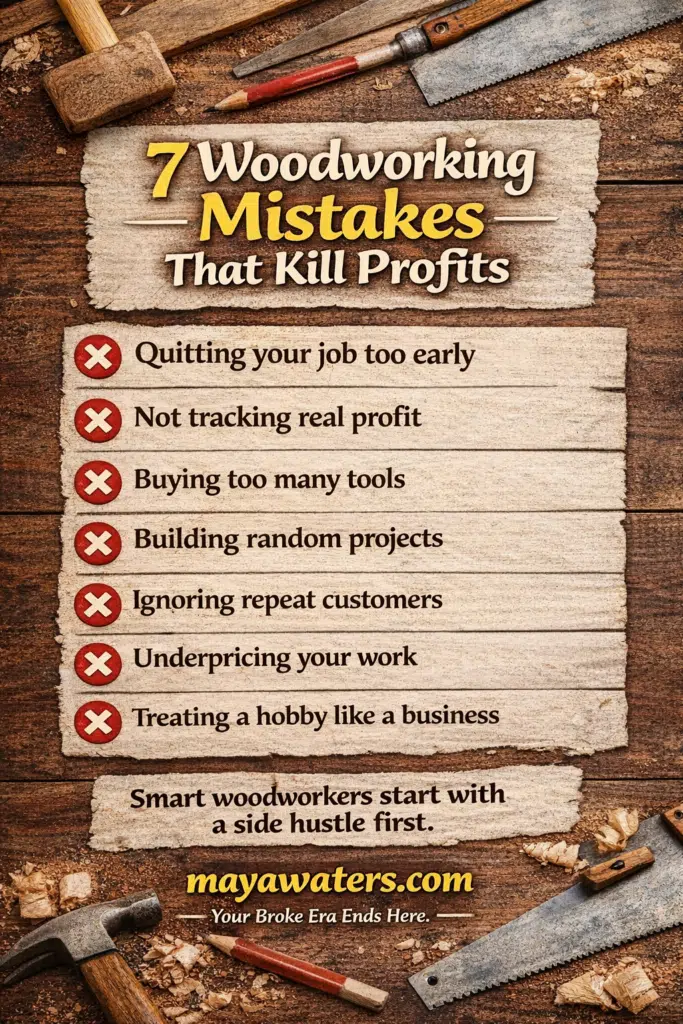
He had:
✅ No plan (and I mean zero)
✅ No system for getting customers
✅ No clue what he was actually making per table
Because here’s the thing about woodworking jobs that people forget.
Wood costs money.
Tools cost money.
Gas costs money.
And your time? That costs money too.
Once you subtract materials, tools, wear and tear, and the hours he spent sanding like a man possessed…
His “profits” were basically beer money.
And not even fancy craft beer either.
I’m talkin’ gas-station 6-pack money at best!
Sadly, it was just within a few months, when things went downhill (fast!).
✅ His savings were gone
✅ His stress was sky high
✅ His health took a nosedive
Turns out financial panic pairs very poorly with power tools.
The Right Way to Start Woodworking Jobs (Without Ruining Your Life)
Here’s my free advice darlin’….
Do not quit your job first.
Do not try to “manifest” your mortgage payment.
And pleeeease… do not confuse a couple lucky sales with a “real business”.
Because that’s how people turn exciting ideas into very expensive life lessons. And these days, life is too hard and unpredictable to learn life lessons the hard way.
So, if you’re serious about turning woodworking into a real side hustle, one of the smartest things you can do is learn what actually sells before you start building random projects.
One resource a lot of beginners use is the WoodProfits guide, which walks through the exact products that tend to sell well, where to find buyers, and how to turn a garage shop into a profitable woodworking business.
Step 1: Start Woodworking as a Side Hustle
Keep your job.
📌 Build your projects at night.
📌 Sand wood on the weekends.
📌 Let your regular paycheck quietly fund all the little mistakes you’re going to make while learning.
Because trust me… there will be mistakes.
That’s not failure. That’s training.
Starting woodworking jobs as a side hustle first lets you figure things out without financial panic breathing down your neck.
And panic is a terrible business partner.
So, if you need a little extra cash while you’re getting your woodworking side hustle off the ground, there are actually some ridiculously easy ways to make money online in the meantime.
One of the easiest ways isuser testing websites, where companies literally pay you to test apps and/or websites and give feedback. In fact, I just wrote a full guide about how to get paid for user testing, so definitely check it out 🙂
Don’t Build Random Stuff Hoping It Sells
Here’s a mistake a lot of beginners make when they first start woodworking.
They build whatever feels fun at the time….
📌 One weekend it’s a coffee table.
📌 Next weekend it’s a cutting board.
📌 Then suddenly they’re building a birdhouse… for reasons nobody understands.
The problem?
Not everything people build actually sells.
That’s why many new woodworkers end up with a garage full of beautiful projects… and zero customers.
If you’re serious about turning woodworking into real income, the smartest thing you can do is learn what people are already buying.
There’s actually a guide called WoodProfits that walks through the exact woodworking projects that tend to sell well and how people turn small garage shops into profitable woodworking businesses.
It basically helps beginners skip the whole trial-and-error phase that eats up a lot of time and money.
Because let’s be honest… lumber isn’t exactly cheap these days.
Step 2: Track Real Profit (Not Just Sales)
Selling a table for $500 does not mean you made $500.
I know. I wish it worked that way too.
But when it comes to woodworking jobs, you have to do the boring adult thing called math.
Because that $500 table still has expenses hiding inside it.
You need to subtract:
✅ Materials
✅ Tools
✅ Sandpaper, stain, screws, and all those “little things” that somehow cost $80 every trip to the hardware store
✅ Your time (yes, your time matters)
If you’re making $40 after spending 12 hours building something… that’s not a thriving woodworking business.
That’s a very expensive hobby.
And if the profit doesn’t make sense now, it won’t magically get better later.
Step 3: Prove You Can Get Consistent Clients
One-off buyers don’t pay rent.
You need:
💰 Repeat customers
💰 Referrals
💰 Or a steady stream of new leads
Facebook Marketplace, Etsy, local contractors, home builders, custom orders. Whatever your lane is, prove it works consistently.
Step 4: Replace Your Income Before You Quit
This is the rule nobody likes hearing… but it’s the one that keeps your electricity on and your credit score out of witness protection.
Before you dramatically toss your work badge in the air like you’re in a movie montage, ask yourself a few very boring but very important questions:
💰 Can woodworking cover your bills?
💰 Can it do that every single month?
💰 Do you have savings to catch you if a slow month hits?
If the answer to those questions is “uh… not really,” then congratulations. You’re still in the side-hustle phase my dear.
And that’s not a failure. That’s called smart business.
Because the goal isn’t to escape your job in a blaze of glory.
The goal is to quietly build something so solid on the side that one day your job becomes optional.
No panic.
No ramen-for-dinner-until-Thursday situations.
Just smooth, boring, financially responsible success.
Exciting, I know.
But boring money is stable money. And stable money is what pays the mortgage!
⬆️ PIN THIS! ⬆️
Types of Woodworking Jobs That Actually Pay
Now here’s something most woodworking YouTube channels conveniently forget to mention.
Not all woodworking jobs make money.
Some make Instagram posts.
The woodworking businesses that actually pay the bills usually focus on things people need over and over again, not just things that look pretty on a coffee table.
The jobs that tend to scale best include:
📌 Custom cabinetry
📌 Built-ins and storage solutions
📌 for contractors or interior designers
📌 Repetitive, high-demand products
📌 Commercial or bulk orders
See the pattern?
These are projects where once you figure out the process, you can repeat it again and again without reinventing the wheel every time.
That’s where real money starts showing up.
Now let’s talk about the stuff that sounds impressive but quietly murders profit margins.
The woodworking jobs that struggle the most are usually:
✅ One-off “artsy” pieces with no repeat demand
✅ Underpriced custom builds (aka charity work disguised as business)
✅ Projects that take three weeks but only pay like three hours
They’re beautiful.
They’re creative.
They’re also the reason so many talented woodworkers are eating Ramen noodles in their shop at midnight.
Because here’s the hard truth: Pretty doesn’t always pay.
But repeatable work?
That’s where the money lives.
Want to Turn Woodworking into a Real Business?
If you love building things with wood, there’s a big difference between:
Having a hobby
and
Running a profitable woodworking business.
The difference usually comes down to these 3 things:
✅ building projects people actually want
✅ knowing where to find customers
✅ and having a system that brings in steady orders
That’s exactly what the WoodProfits woodworking guide is designed to teach.
It shows beginners how people start woodworking businesses from home, what products sell best, and how to turn woodworking into a real income stream.
And honestly, if woodworking is something you’re seriously interested in, learning from people who have already figured it out can save you a lot of expensive mistakes.
Because trust me… figuring everything out the hard way with power tools involved can get pricey real fast.
The Bottom Line
Woodworking jobs can absolutely change your life.
But not overnight.
Not because you had one great weekend at a craft market.
And definitely not because three coffee tables sold and suddenly you felt like the next HGTV star.
Real businesses don’t grow on inspiration.
They grow on systems, repeat customers, and steady income.
So, take a breath. Slow it down.
💰 Build your skills.
💰 Build your client list.
💰 Build your income before you build your exit plan.
Because the smartest entrepreneurs don’t jump off the cliff and hope a parachute appears.
They sew the parachute first.
And trust me… your future self, sitting in a fully paid-off workshop with steady orders coming in, will be very, very glad you did.
