



Consider this post your human-friendly “what job should I have quiz” (no cheesy pop-ups, I promise), built to help you finally answer the question you’ve been quietly dodging for years: “what career should I have?”.
Better yet, we’re doing this based on how you actually operate as a human in real life, not whatever random career your guidance counselor assigned you back in 2012 like it was some sort of BuzzFeed quiz result!
This Post Is for You If You’re Asking Yourself…
- What job should I have?
- What job should I do if I hate my current one?
- How do I know what job is right for me?
- What is my dream job… and why can’t I figure it out?
So, if it’s 1:27am and you just got here by Googling “what job should I have quiz”, while questioning every life choice you’ve️ ever made….
Oh you poor dear……welcome, you’re among friends now.
How This Quiz Works (Read This First)
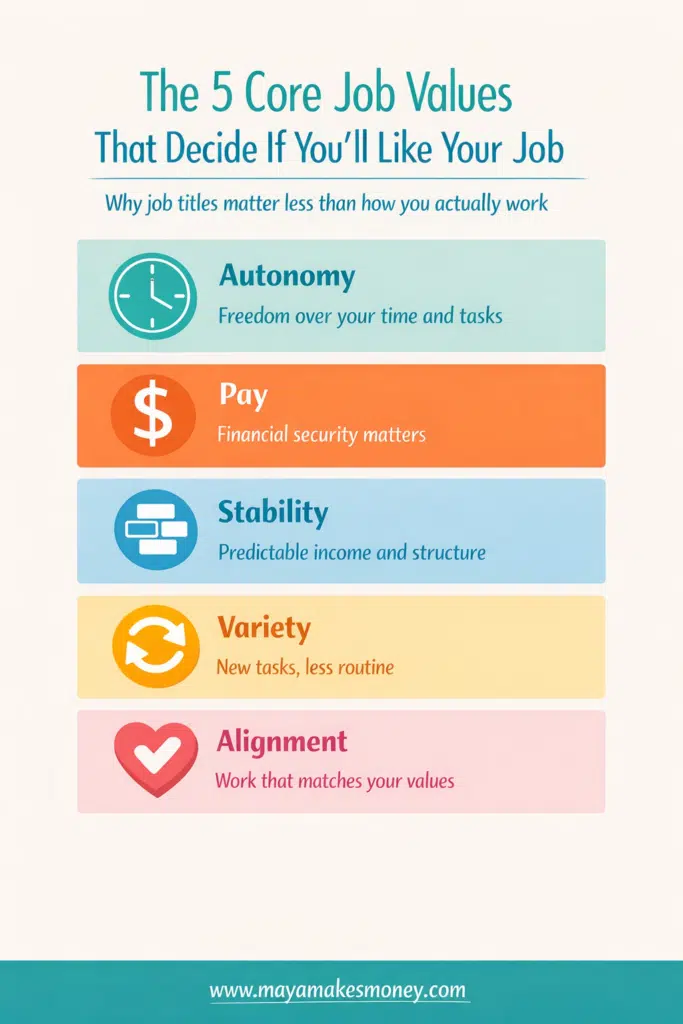
This quiz is based on five core job values:
- Autonomy
- Pay
- Stability
- Variety
- Alignment
Your job is simple:
- Pick your TOP TWO values (they’re equally important)
- Pick ONE value you care the least about (your “throwaway”)
That’s it.
There are no wrong answers. There’s no “best” value. This quiz is about how you actually work as a human, not how you think you should work!
Grab a pen, open your notes app, or mentally scream the answers. All methods are valid. 😉
Step 1: Understand the 5 Core Job Values
Read each value and take note on which ones make you feel like, “Yeah… that’s sooo me!”
1. Autonomy (Freedom)
Autonomy is about how much control you want over things like:
- Your schedule
- Your workload
- How things get done
Autonomy might be a top value if:
- You hate being micromanaged
- Rigid schedules drain you
- You’d rather figure things out yourself than explain them to a supervisor
If “just trust me, I’ve got this” lives in your soul, autonomy likely matters to you.
2. Pay (Money Without Shame)
Pay is not “I want to be a billionaire.”
Pay means:
- Financial security matters to you
- You feel stressed or resentful when money is tight
- You’d choose a higher-paying job even if it’s less exciting or meaningful
Important:
Not choosing pay as a top value doesn’t mean you’re ok with being underpaid or working for pennies. It simply means that money isn’t always at the top of your list when you’re choosing a job.
The American Psychological Association also points out that when people are in jobs that don’t fit them, stress goes up and overall well-being goes down, even if the pay looks good on paper. So, if pay isn’t at the top of your list, you can relax knowing there are actually a lot of benefits to that.
3. Stability (Predictability)
Stability is about:
- Consistent income
- Long-term roles
- Benefits and job security
Stability may be a top value if:
- You like knowing what the next 6–12 months look like
- Gig work makes you anxious
- Constant job hunting sounds exhausting
If “ahh, we’ll figure it out later” makes your chest immediately clench, well, stability probably matters a lot more than you might even think!
4. Variety (Mental Stimulation)
Variety is about:
- How often your tasks change
- Wearing multiple hats
- Not doing the same thing every day
Variety might be important if:
- You get bored easily
- Routine drains you
- You like learning on the fly
If doing the same thing over and over makes you quietly question your entire existence, variety is probably non-negotiable for you.
5. Alignment (Meaning & Values)
Alignment is how much your job matches:
- Your personal values
- Your identity
- Your sense of purpose
Alignment matters if:
- You care about the mission behind your work
- You struggle working for companies you don’t believe in
- Meaning matters more than titles
If you’ve ever said, “I can’t sell this, it feels wrong,” then alignment is probably super important to you.
⬆️PIN THIS! ⬆️
Step 2: Choose Your Values
Now make your picks!
Your Choices:
✅ Top Two Values (circle two):
Autonomy / Pay / Stability / Variety / Alignment
❌ Throwaway Value (circle one):
The value you care the least about when choosing a job
Don’t overthink it. Your first instinct is usually right.
Step 3: Find Your Career Archetype
(This is the results part of the “what job should I have quiz”)
Your top two values decide your career archetype.
Your “throwaway value” just adds a little extra detail, but you don’t need it to find your main match.
Scroll down until you see your combo below.
Career Archetype Results
Independent Earner
Top Values: Autonomy + Pay
You want to make money, but on your own terms.
Micromanagement is a dealbreaker. Endless meetings are your villain origin story.
Best-fit careers:
- Freelance creative work (writing, design, video, branding)
- Consulting or contract-based roles
- Small business or online business ownership
- Startup or solo founder paths
If control matters more than certainty, this is you.
Escape Artist
Top Values: Autonomy + Variety
You crave freedom and stimulation.
Routine makes you restless. Structure makes you itchy.
Best-fit careers:
- Creative direction or brand strategy
- UX research or innovation roles
- Product design
- Flexible, project-based, or entrepreneurial work
You thrive when you can pivot without asking permission.
Principled Builder
Top Values: Autonomy + Alignment
You want meaningful work and independence.
You don’t just want to follow a mission. You want to shape it.
Best-fit careers:
- Early-stage startups with real purpose
- Ethical consulting (DEI, sustainability, impact)
- Systems-change or activism-adjacent strategy work
If your job doesn’t align with your values, you won’t last. Period.
Prestigious Idealist
Top Values: Pay + Alignment
You want your work to matter and pay well.
You are not working for exposure. Ever.
Best-fit careers:
- Climate tech or mission-driven startups
- Social impact PR or public-facing leadership roles
- B-corps or value-aligned companies with real budgets
You refuse to choose between meaning and money.
Steady Climber
Top Values: Pay + Stability
You like structure, progression, and predictability.
Clear ladders. Clear titles. Clear raises.
Best-fit careers:
- Government or public sector roles
- Corporate management
- Finance, accounting, or consulting
- Large organizations with defined promotion paths
You thrive where consistency is rewarded.
Adaptive Hustler
Top Values: Pay + Variety
You like fast-paced work, new challenges, and getting paid for it.
No two days should look the same.
Best-fit careers:
- Creative agency work
- Brand strategy or media roles
- Event planning or production
- Contract or multi-income careers
You learn on the job and figure things out as you go.
Steady Individualist
Top Values: Autonomy + Stability
You want security without being hovered over.
Predictable work, done your way.
Best-fit careers:
- Operations or project management
- Compliance or systems roles
- Academic or research coordination
- Specialist consulting within stable organizations
You like structure, but you want control inside it.
Structured Explorer
Top Values: Stability + Variety
You need mental stimulation without chaos.
Too boring drains you. Too unpredictable stresses you out.
Best-fit careers:
- Product management
- Teaching (with strong institutional support)
- Healthcare roles with rotation (nursing, radiology, therapy)
- Policy or nonprofit operations
You want novelty, but with a safety net.
Purposeful Planner
Top Values: Stability + Alignment
You want steady, meaningful work that actually helps people.
You’re quietly idealistic and long-term focused.
Best-fit careers:
- Education administration
- Public health or therapy
- Policy or nonprofit strategy
- Ethics, compliance, or governance roles
Slow and meaningful beats fast and empty for you.
Spontaneous Romantic
Top Values: Variety + Alignment
You want work that feels expressive, creative, and emotionally connected.
Monotony kills your soul.
Best-fit careers:
- Writing, filmmaking, storytelling
- Art direction or experience design
- Culture, identity, or community-focused roles
- Multidisciplinary creative work
You thrive where meaning and creativity overlap.
According to research from Gallup, people are happier and more engaged at work when their job fits how they work best and what they value, not just because of a fancy title or a bigger paycheck.
Final Reminder (Read This Twice)
This what job should I have quiz isn’t about finding one perfect job.
It’s about understanding:
- What drains you
- What energizes you
- What you actually need to stay satisfied long-term
Careers are experiments, not life sentences.
Now you’re choosing from clarity instead of panic.
How Do I Know I’m Doing the Right Job?
Before we talk about job titles, we need to zoom out for a second.
Most people struggle with “how do I know I’m doing the right job?” because they jump straight to job titles instead of asking the question that actually matters:
What kind of work do I enjoy doing day to day?
Not what sounds impressive.
Not what your aunt keeps suggesting at family dinners.
Not what looks flashy on TikTok.
The truth is, there are four main work styles that most jobs fall into. Almost every career fits into at least one of these (and sometimes overlaps).
When your job matches your work style, that’s usually the biggest sign you’re in the right place.
⬆️PIN THIS! ⬆️
The 4 Career Categories
Arts & Humanities Jobs (Creators & Communicators)
You might lean this way if you enjoy:
- Writing, reading, or storytelling
- Designing, creating, or brainstorming
- Expressing ideas visually or verbally
Common Arts & Humanities careers include:
- Writers and editors
- Designers and marketers
- Content creators
- Journalists
- Museum, gallery, or publishing roles
💡 Reality check:
Not all creative jobs are starving-artist energy. Some are stable, boring-but-secure corporate roles that still use creative skills. You can mix passion with practicality.
STEM Jobs (Problem Solvers & Builders)
You might lean STEM if you like:
- Logic, systems, and structure
- Solving problems step-by-step
- Working with data, code, or science
STEM includes:
- Software developers
- Engineers
- Data analysts
- Healthcare professionals
- Cybersecurity and IT roles
💡 Good to know:
Some STEM jobs are repetitive and rigid. Others are flexible, creative, and project-based. Not all STEM = lab coat misery.
Policy & Change-Making Jobs (Big Picture Thinkers)
This category fits people who ask:
- “Why does the system work like this?”
- “How do we fix this?”
Careers here include:
- Policy analysts
- Social workers
- Nonprofit leaders
- Campaign strategists
- Government or advocacy roles
💡 Heads-up:
Change can be slow. Meetings can be endless. But if you care deeply about impact, this might be your lane.
Physical & Skilled Labor Jobs (Hands-On Doers)
You might prefer this if:
- Sitting at a desk makes you feral
- You like tangible results
- You enjoy working with your hands
Examples include:
- Trades (electrician, mechanic, carpenter)
- Firefighters and paramedics
- Technicians and operators
- Skilled artisans
💡 Important note:
These jobs are often highly paid, in demand, and overlooked. College is not required to succeed here.
What Job Should I Have Based on How I Like to Work?
Once you know your category, the next question is how you want to work.
Independent vs Institutional Work
Ask yourself:
- Do I want flexibility and autonomy?
- Or structure, stability, and clear expectations?
Independent work often includes:
- Freelancers
- Self-employed creators
- Contractors
Institutional work includes:
- Companies
- Government
- Universities
- Established organizations
Neither is better. One just matches your nervous system better.
How Much Training Are You Willing to Do?
This is where people get stuck asking “what career should I have” without being honest.
Be real with yourself:
- Are you willing to do years of school?
- Or do you prefer learning on the job?
Some careers require:
- Degrees
- Certifications
- Apprenticeships
Others value:
- Experience
- Portfolios
- Skill proof
There is no moral bonus for suffering longer in school.
How to Know What Job Is Right for You (The Honesty Test)
If you’re still unsure, answer these without overthinking:
- Do I prefer people, ideas, systems, or things?
- Do I want predictable days or variety?
- Do I care more about meaning or money?
- Do I want flexibility or security?
- Do I want to sit, stand, move, or build?
Your answers point to what should my job be more clearly than any personality quiz ever will.
What Is My Dream Job… Really?
Here’s the truth nobody says out loud…
Your dream job doesn’t have to:
- Be your passion
- Fulfill your soul
- Define your identity
Sometimes the dream is:
- A job you don’t hate
- That pays your bills
- And leaves you with energy for life
That still counts.
What Career Should I Choose If I Still Feel Lost?
If you’re overwhelmed, do this instead:
- Pick one category
- Pick one work style
- Pick one training level
- Test it for 6–12 months
Careers are experiments, not tattoos.
Never forget this: it’s okay to change course.
What Job Should I Have FAQ
What job should I have if I don’t know what I like?
Start with what you don’t like. Eliminate first. Clarity comes faster that way.
What job should I do if I hate my current career?
Look for adjacent skills you can transfer instead of starting from zero.
How do I know what job is right for me long term?
You don’t. You choose the best option with the information you have now.
What should my job be if I want flexibility?
Independent, project-based roles or skilled trades often offer the most control.
What career should I have if I don’t want college?
Trades, tech, creative, and many service roles value experience over degrees.
The Bottom Line
If you’re still hoping for a magical “what job should I have quiz” that spits out one perfect answer and solves your whole life, I hate to break it to you… that’s not how it works.
The real answer isn’t going to be found in a list of job titles.
It’s knowing:
- How you like to work
- What you’re willing to learn or train for
- What kind of life you want outside your job
Once you understand those things, the noise dies down. The panic eases up.
Bet of all, decisions start to feel clearer instead of stressful.
That’s how you know you’re on the right track.
