


This post is all about living frugal tips that will help you save money without sacrificing your happiness.
The truth is the word frugal has a weird reputation. When people think frugal, they immediately think of someone in the dark with a candle, not turning on the lightbulb to conserve electricity.
Girrrrl, that’s not frugal!
That’s just depressing.
Real, long term, effective frugal living is not that extreme. And that’s not ‘different’ that’s just sad.
It’s about being intentional with your money so that you stop wasting it on things that don’t actually improve your life.
And once you start paying attention to where your money goes, something surprising happens.
You realize a lot of spending isn’t necessary at all.
It’s just habits.
The good news?
Habits can change!
The living frugal tips in this guide are things that real people use every day to reduce their spending without feeling deprived.
Some will save you money by small amounts.
Others will quietly save you hundreds or thousands of dollars each year.
And when those savings begin to add up?
Well, that’s when your “broke girl era” slowly starts to pack its bags.
TL; DR — The Most Powerful Living Frugal Tips
If you want to start saving money quickly, these living frugal tips make the biggest impact:
✅ Plan your grocery shopping before going to the store
✅ Stop paying for unused subscriptions
✅ Buy second-hand items
✅ Cook more meals at home
✅ Use less energy at your house
✅ Avoid impulse purchases
✅ Track where your money is going
Frugal living works best when you focus on small daily habits instead of extreme sacrifices.
When these habits become routine, saving money becomes automatic.
What are the Best Living Frugal Tips?
The best living frugal tips focus on reducing everyday expenses while still allowing you to enjoy life.
Practical strategies like meal planning, comparison shopping, lowering utility costs, and avoiding impulse purchases help people keep more of their money each month without feeling restricted.
These habits work because they help you:
- Spend intentionally instead of emotionally
- Reduce recurring monthly expenses
- Avoid wasting money on things you don’t need
- Use what you already own first
- Build smarter financial habits over time
Next, we’ll look at 33 living frugal tips that can immediately help you spend less and save more.
⬆️ PIN THIS! ⬆️
33 Living Frugal Tips That Actually Save You Money
1. Start With Your Grocery Bill
Groceries are one of the fastest places money quietly disappears.
I once ran into the store for “just a few things” and somehow walked out $48 poorer with a cart full of Kit Kats, Ben & Jerry’s, Oreos, and a bag of chips the size of a pillow. Half the stuff wasn’t even on my mental list. In fact, I’m pretty sure dinner wasn’t even in the cart anymore.
“Once” …. haha, who am I kidding!? That happens every single time I shop without a list.
2. Eat the Food You Already Bought
This might be the most overlooked living frugal tip ever.
People will say groceries are expensive while a half-forgotten science experiment grows in the back of their fridge.
Before buying new food, check what you already have.
Leftovers can turn into:
- soups
- wraps
- stir-fry
- pasta
Your fridge might already contain tomorrow’s dinner.
3. Wait 24 Hours Before Buying Non-Essentials
Impulse purchases are sneaky.
You see something.
Your brain says, “I deserve this.”
Next thing you know, Amazon is knocking at your door.
A simple trick is the 24-hour rule.
If you still want the item tomorrow, buy it.
Most of the time you’ll forget about it completely.
And that means money stays in your pocket.
4. Stop Paying for Subscriptions You Forgot About
Subscriptions are the quietest money leak on the planet.
Streaming services. Apps. Memberships.
Five or six small subscriptions can easily become $60–$100 a month.
Do a quick audit of your bank statement.
If you haven’t used something in the last month, cancel it.
Future you will not miss it.
5. Buy Second-hand Before Buying New
This is one of the most powerful living frugal tips out there.
So many things’ people donate are practically brand new.
Furniture. Kitchen gadgets. Clothes. Decor.
Check places like:
💰 Facebook Marketplace
💰 thrift stores
💰 community groups
Buying used can cut costs by 50–80%.
And your wallet will notice.
6. Cook at Home More Often
Restaurant meals are convenient.
They’re also expensive.
A single takeout meal can cost the same as 3 or 4 home-cooked meals.
Cooking doesn’t need to be complicated either.
Simple meals like:
- pasta
- tacos
- stir-fry
- soup
Will feed a whole family for the price of one restaurant order!
7. Use the “Use It Up” Rule
Before buying something new, ask yourself:
“Do I already own something that can do this?”
For example:
- old jars become storage containers
- leftover veggies become soup
- extra bread becomes croutons
Frugal living is often about using things completely, not replacing them early.
8. Turn Saving Into a Game
Saving money feels easier when it becomes a challenge.
Try small challenges like:
✅ No-spend weekends
✅ Pantry cooking weeks
✅ $10 thrift store outfits
When saving becomes fun instead of restrictive, people stick with it longer.
And consistency is where the real savings happen.
9. Lower Your Energy Use Without Freezing
You don’t need to sit in the dark like a Victorian ghost to save on electricity.
Small changes help:
- turn lights off in empty rooms
- unplug unused electronics
- use natural light during the day
These tiny habits can reduce your energy bill more than you’d expect.
If you want even more ideas, ENERGY STAR has a great guide showing simple ways to lower your energy use at home.
10. Avoid “Convenience Spending”
Convenience is expensive.
✔️ Pre-cut fruit.
✔️ Pre-made meals.
✔️ Delivery fees.
Those little conveniences add up fast.
Whenever possible, do the small task yourself.
It might take five extra minutes, but it often saves real money.
11. Track Your Spending Once a Week
Here’s the truth many people don’t want to hear.
You can’t fix what you don’t track.
So, once a week, review where your money has gone. You can use a simple budget worksheet like the one from Consumer.gov to make tracking you’re spending much easier.
And listen, it’s not to judge yourself either. Just so you understand it. Because once you see your spending patterns, you can start making smarter choices.
And that’s where frugal living really begins.
More Living Frugal Tips That Add Up Fast
12. Drive Your Car Like It’s Expensive… Because It Is
Cars are one of the most expensive things most people own.
So, treating your car like a race car at every red light is basically throwing money out the window in gas and maintenance.
✔️ Gentle acceleration.
✔️ Smooth braking.
✔️ Regular oil changes.
Your car will last longer, and your wallet will quietly breathe a sigh of relief.
13. Combine Errands into One Trip
Ever notice how one “quick stop” somehow turns into three stores, two drive-thrus, and a coffee you didn’t plan to buy?
Running errands randomly wastes both gas and money.
Instead, group your errands together and do them in one trip.
Less driving means:
✔️ less fuel
✔️ less temptation to spend
✔️ more time back in your day
Your future self will appreciate it.
14. Stop Buying Clothes for Your “Fantasy Life”
We’ve all done this.
You buy a dress thinking you’re about to become the type of person who attends garden parties and drinks sparkling lemonade on patios.
Meanwhile your real life is sweatpants and grocery runs.
Before buying new clothes, ask yourself:
“Would I wear this next week?”
If the answer is no, leave it.
15. Build a Small “Emergency Buffer”
One reason people struggle financially is because every unexpected expense feels like a disaster.
Car repair? Panic.
Vet bill? Panic.
Even saving $500–$1000 as a small buffer can prevent a lot of stress and debt.
Frugal living isn’t just about spending less.
It’s also about protecting yourself from surprises.
16. Learn One Basic Repair Skill
YouTube has quietly become the greatest frugal living teacher on earth.
Instead of paying someone for every tiny repair, learn simple skills like:
✔️ fixing a leaking faucet
✔️ patching small wall holes
✔️ replacing light fixtures
These small skills can save hundreds of dollars over time.
And honestly, it feels kind of satisfying.
17. Borrow Instead of Buying
Some items barely get used.
Things like:
✔️ power tools
✔️ carpet cleaners
✔️ specialty kitchen gadgets
Instead of buying them, borrow from friends, neighbors, or local lending libraries.
Your garage doesn’t need to become a museum of rarely used purchases.
18. Use Cash for “Fun Spending”
Cards make spending feel invisible.
Swipe. Tap. Done.
Cash makes spending feel real.
When you physically see the money leaving your wallet, it’s much easier to stop before things get out of control.
Some people call this the “envelope method.”
I call it “the reality check method.”
19. Avoid the “Small Treat Trap”
Now listen… I am not anti-treat.
Life without treats is just sadness.
But daily treats can become sneaky budget killers.
A $6 coffee 5 days a week is over $1200 a year.
Still enjoy your treats.
Just don’t let them quietly multiply into a second rent payment.
20. Declutter Before You Buy More Stuff
Sometimes the best frugal tip is simply realizing you already own too much.
Decluttering often reveals:
✔️ duplicate kitchen tools
✔️ unopened beauty products
✔️ clothes you forgot existed
Before buying anything new, check your own house first.
You might discover you already bought it.
Twice.
21. Avoid “Lifestyle Inflation”
This is the trap that catches a lot of people.
You earn a little more money… and immediately start spending a little more money.
✔️ Better phone.
✔️ More takeout.
✔️ Fancier everything.
Instead of upgrading your lifestyle every time your income rises, keep some of that extra money.
Trust me, “future you” will be very grateful. 😉
22. Remember That Marketing Is Designed to Trick You
Companies spend billions studying human psychology.
Their job is literally to convince you to buy things you don’t need.
✔️ Flash sales.
✔️ Limited time offers.
✔️ “Only two left in stock.”
Once you recognize those tricks, they lose a lot of their power.
And suddenly your spending decisions become a lot smarter.
Final Living Frugal Tips That Make a Huge Difference
23. Buy Generic Groceries First
One of the easiest living frugal tips is choosing store brands.
A lot of the time, the only difference between name brands and generic brands is the packaging.
✔️ Same ingredients.
✔️ Same size.
✔️ Half the price.
Start trying generic versions of the things you buy regularly.
You might discover your wallet likes them even more than your taste buds notice.
24. Freeze Food Before It Goes Bad
Food waste is basically throwing money in the garbage.
But your freezer is like a little pause button for groceries.
You can freeze things like:
✔️ bread
✔️ meat
✔️ cooked meals
✔️ fruit for smoothies
Instead of tossing food that’s about to expire, freeze it and use it later.
Your grocery budget will thank you.
25. Stop Paying Full Price for Household Items
Cleaning supplies, paper products, and toiletries go on sale all the time.
Instead of buying them the moment you run out, buy extras when they’re discounted.
Over time you build a small stockpile at the lowest price, not the highest.
It’s a simple strategy, but it works surprisingly well.
26. Sell Things You Don’t Use
Frugal living isn’t only about spending less.
Sometimes it’s about turning clutter into cash.
Things you might be able to sell include:
✔️ old electronics
✔️ furniture
✔️ clothes
✔️ collectibles
That random item sitting in your closet might actually be worth money.
27. Plan “No-Spend Days”
A fun challenge is creating no-spend days.
On those days, you simply avoid buying anything that isn’t necessary.
✔️ No online shopping.
✔️ No takeout.
✔️ No impulse purchases.
It’s surprising how quickly these days help reset spending habits.
28. Pack Snacks When You Leave the House
Leaving the house hungry is dangerous for your wallet.
Suddenly a $4 snack becomes a $12 meal.
Packing simple snacks like granola bars, fruit, or nuts prevents those random purchases that add up fast.
Your stomach stays happy and your budget stays intact.
29. Use What You Already Own First
This is a big one.
People constantly buy new things while perfectly good items sit unused at home.
Before buying something new ask yourself this……
“Do I already own something that can do this?”
Half the time, the answer is yes.
And that means you just saved money.
30. Limit Online Shopping Browsing
Online stores are designed to keep you scrolling forever.
And the longer you browse, the more likely you are to buy something you didn’t need five minutes ago.
Try limiting how often you “window shop” online.
Because sometimes the easiest way to save money is simply not opening the shopping app.
31. Use the “Cost Per Use” Rule
Before buying something, ask yourself how often you’ll use it.
If you spend $100 on something you’ll use 200 times, that’s only 50 cents per use.
But if you spend $50 on something you’ll use once… that’s not such a great deal.
Thinking about purchases this way helps you spend smarter.
32. Focus on Value, Not Just Price
Sometimes the cheapest option ends up costing more in the long run.
If something breaks quickly or needs replacing often, it’s not actually saving money.
Frugal living means finding the best value, not just the lowest price.
Quality matters too.
33. Remember That Frugal Living Is About Freedom
The real goal of frugal living isn’t deprivation.
It’s freedom.
When you spend less on things that don’t matter, you gain more options in life.
✔️ Less stress.
✔️ More savings.
✔️ More control over your future.
And honestly, that feeling is worth way more than any random purchase.
Frugal Living Habits That Can Save You $5,000+ Per Year
Some living frugal tips save a few dollars here and there. Others quietly save thousands over time.
If one of your goals is saving for a down payment, these habits can make a huge difference. I actually break this down step-by-step in my guide on how to save money for a house.
Because when people consistently apply several frugal habits together, the yearly savings can add up faster than expected.
Here are some examples of where the biggest savings usually happen:
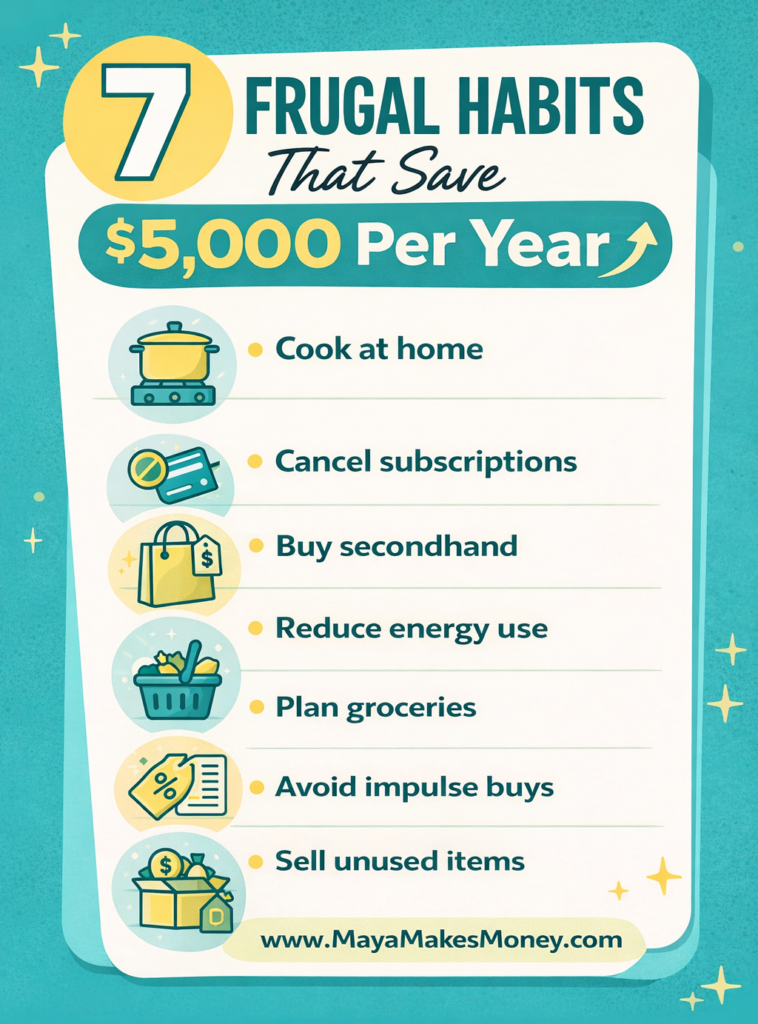
- Cooking at home instead of frequent takeout
- Reducing unnecessary subscriptions
- Buying second-hand furniture and clothing
- Lowering electricity and heating usage
- Avoiding impulse purchases
- Meal planning groceries each week
- Selling unused items around the house
When these habits become routine, many households find they save $3,000–$5,000 per year or more without drastically changing their lifestyle.
Frugal living isn’t about cutting joy out of life.
It’s about removing the spending that doesn’t actually make life better.
⬆️ PIN THIS! ⬆️
Frugal Living Starter Challenge: A 7-Day Reset That Won’t Make You Miserable
If you want to start using these living frugal tips right away, this little 7-day reset is a great place to start.
✅Nothing dramatic.
✅Nothing weird.
✅No eating plain rice in the dark to “save money.”
Just one small habit a day to help you notice where your money is going and where it keeps quietly sneaking out the back door like a little thief.
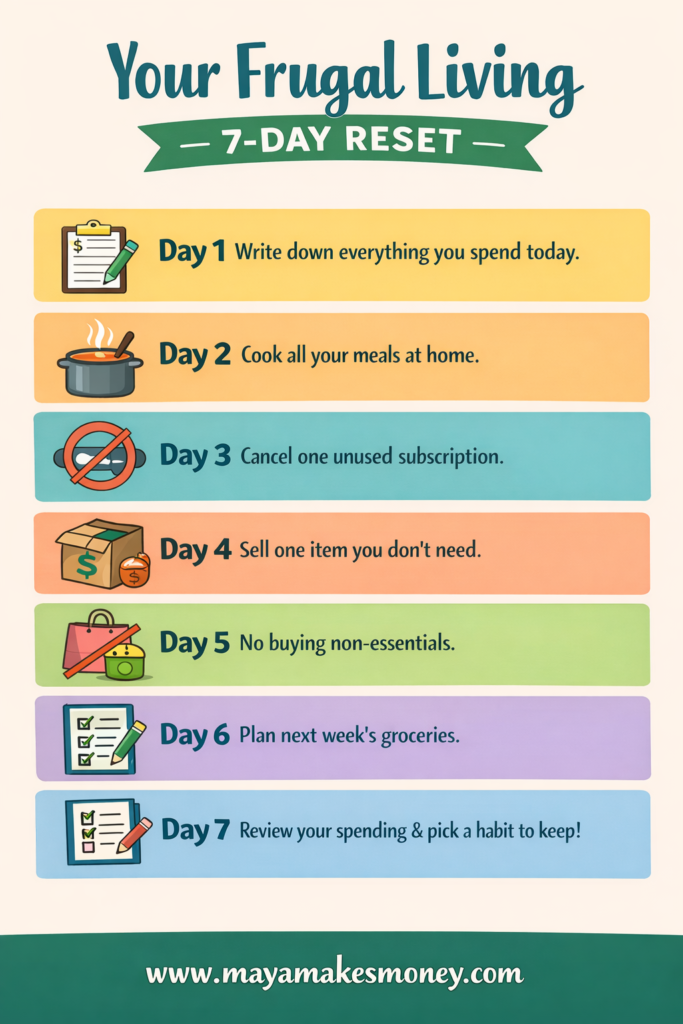
Day 1: Track every dollar
Write down every single dollar you spend today.
Yes, even the drink.
Yes, even the random snack.
Yes, even the “it was only five bucks” thing that somehow happens six times a week.
This is the day you stop guessing and start looking at your money with both eyes open.
Day 2: Cook every meal at home
For one full day, eat every meal at home.
Breakfast, lunch, dinner, snacks. All of it.
This is where a lot of people realize how fast “just grabbing something quick” turns into a grocery bill plus a takeout bill plus regret.
Day 3: Cancel one useless subscription
Pick one subscription you do not actually use and cancel it.
That free trial from the Stone Age? Gone.
That app you forgot existed? Gone.
That streaming service you only use to scroll and not watch? Also gone.
Tiny move, but it feels powerful.
Day 4: Find one thing you can sell
Walk around your house and find one item you could sell.
Old decor, clothes, a kitchen gadget you swore you’d use, random electronics, whatever.
Frugal living is not just about spending less. It is also about making your stuff work for you.
Day 5: Buy nothing extra
Today is a no non-essential spending day.
Bills are fine. Groceries you truly need are fine.
But the cute little impulse buys? The “treat yourself” nonsense? The dollar aisle traps? Not today, my friend.
Your money gets to stay home with you.
Day 6: Plan groceries before you shop
Before you even think about stepping into a store, plan next week’s groceries.
✅Check what you already have.
✅Plan simple meals.
✅Make a list.
Stick to it like your budget depends on it, because honestly… it kind of does.
This one habit alone can save you from a shocking amount of budget damage.
Day 7: Review and keep one habit
Look back at your week and review your spending.
What surprised you?
What felt easy?
What helped the most?
Now choose one habit to keep doing every week.
That is how frugal living sticks. Not by changing your whole life overnight, but by keeping the small things that actually work.
A lot of people notice that after just one week of paying attention to their spending, their habits start shifting on their own.
And that is when frugal living stops feeling like punishment… and starts feeling like control.
Quick Frugal Living Checklist
If you want to start applying these 7 living frugal tips today, try this quick checklist:
✅Shop with a grocery list
✅Cancel unused subscriptions
✅Cook more meals at home
✅Compare prices before buying
✅Buy second-hand when possible
✅Reduce food waste
✅Track your weekly spending
Even implementing a few of these habits can make a noticeable difference in your budget.
The Bottom Line
Living frugal doesn’t mean living poorly.
It simply means being intentional with your money.
When you apply these living frugal tips, small savings begin stacking up everywhere.
If you want something that actually puts money in your pocket, check out these fast-paying websites that can help you earn online much faster.
A few dollars here.
Ten dollars there.
Eventually those savings turn into something bigger:
✔️ less financial stress
✔️ more breathing room in your budget
✔️ and the ability to plan your future.
Frugal habits might seem small in the moment.
But over time, they quietly change your financial life.
If you’re interested in increasing your income instead of only cutting expenses, you might also like my guide on how to start a blog where I walk through how beginners can build an online income step-by-step. It’s my personal favorite, but I might be a lil’ bias 😉
Living Frugal Tips FAQ
What does living frugal mean?
Living frugal means spending money carefully and avoiding unnecessary expenses. It focuses on making thoughtful choices with your money so you can save more and reduce financial stress.
What are the best living frugal tips for beginners?
Some of the best beginner tips include meal planning, comparison shopping, cooking at home, reducing food waste, and tracking spending habits. These small changes can quickly lower monthly expenses.
Can frugal living really save a lot of money?
Yes. Many people save hundreds or even thousands of dollars each year simply by changing everyday spending habits like groceries, subscriptions, and energy usage.
Is frugal living the same as being cheap?
No. Being cheap focuses only on spending less, while frugal living focuses on spending smartly so you get the most value from your money.
