


What if I told you that you could get paid to sleep, and yes, that sentence still feels fake as I type it now. But it’s not fake. Not clickbait. Not a weird internet lie. It’s 100% Real.
I mean, wow…. If you told me 10 years ago that people would be asking me how to get paid in your sleep — literally — I would’ve assumed it involved a pyramid scheme, a camera, or a very questionable contract to say the least.
But here we are.
And somehow, getting paid for sleeping is a real thing.
Not “become rich overnight” real, but legit side-money, free mattress, science-needs-you real.
So, let’s break it down properly — what’s real, what’s hype, and what really makes sense if you’re someone who wants to get paid to sleep without selling your soul or live-streaming yourself drooling on the internet. Ew.
What “Get Paid to Sleep” Actually Means
Alrighty, before anyone shuts off their alarm and quits their job, let’s be crystal clear about something.
When people say, “get paid to sleep, they’re not usually talking about curling up under a blanket and magically earning money in your dreams. I wish. We’d all be rich by midnight.
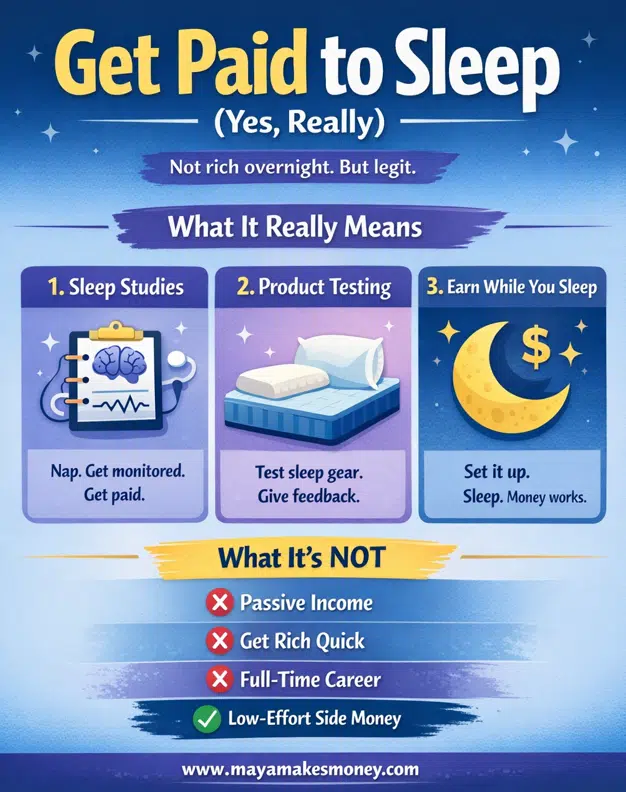
Most of the time, when you learn how to get paid to sleep it actually means one of these three very real, very “ahhh, okay-this-makes-sense-now” situations:
- You’re part of a sleep study or research project
Scientists want to watch how you sleep. You nap. They take notes. You get paid. Slightly creepy? Maybe. Effective? Absolutely. - You’re testing sleep-related products
Think mattresses, pillows, sleep trackers, or fancy eye masks that promise “celebrity-level rest.” You sleep on the product, give feedback, and yes… you get paid to sleep. - You’re doing work that earns money while you sleep
This is the “I set it up once and it keeps working overnight” kind of deal. You’re not getting paid instead of working. You’re getting paid while you’re knocked out, drooling on your pillow like a champion.
So no, it’s not a scam. And no, it’s not a fairytale. But getting paid to sleep doesn’t mean unlimited naps with zero effort either. We could only wish!
But no, it really just means that your sleep might finally start pulling its own financial weight. Who would’ve thought hey!
What getting paid to sleep is not
- Passive income
- “Make money doing nothing”
- A daily full-time career (unless you go very niche)
But it is one of those weird corners of the internet where money and pajamas accidentally overlap.
1. Sleep Studies That Pay Real Money
Sleep studies are hands down the most legit, least “sketchy” way to get paid for sleeping.
Not every “get paid to sleep” opportunity is BS. Some of the most legit options come from clinical sleep studies, where real researchers pay participants to help them understand sleep patterns, disorders, and overall health.
These studies are usually run through universities, hospitals, or research programs connected to organizations like the National Institutes of Health, which means they’re structured, regulated, and very clear about what you’re signing up for.
No weird surprises. No sketchy promises. Just science that needs sleepy humans.
How sleep studies work:
- You apply online
- Fill out health and sleep questionnaires
- If selected, you sleep either at home or in a sleep lab
- You get paid for your time
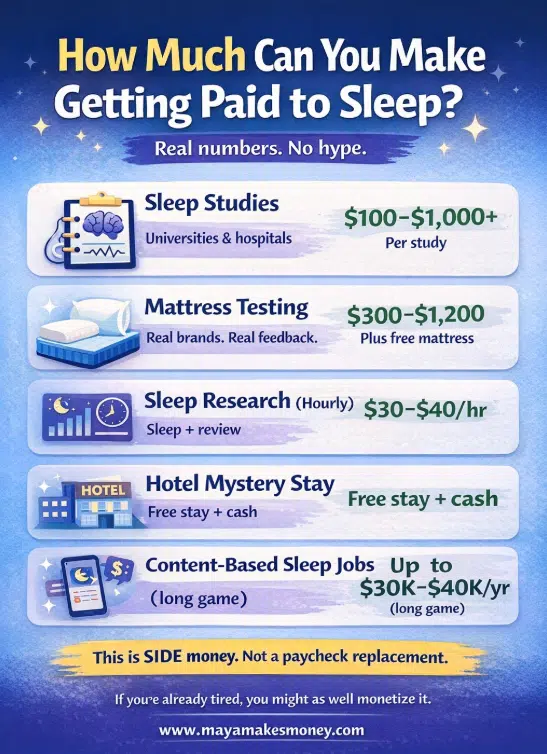
Some studies pay per night. Others pay hourly. Some pay hundreds for multi-day studies.
Where to find sleep studies:
- Sleep research centers
- University medical programs
- Sleep-focused research organizations
- Foundations dedicated to sleep health
If you struggle with insomnia or have weird, off-schedule sleep patterns, this might actually work in your favor.
✅ Believe it or not, people who don’t sleep normally are usually more “valuable” for studies and testing.
Researchers aren’t looking for perfect sleepers. They’re looking for real humans who toss, turn, wake up at 3 a.m. for no reason, or stare at the ceiling replaying their life choices, all night long.
✅ If your sleep schedule has always been a little “chaotic” to say the least, that won’t disqualify you, that’s for sure! If anything, it’ll probably help you get paid to sleep, a lot more than someone who knocks out the second their head hits the pillow.
Yes, struggling to sleep can literally make you money here.
So if you’re curious about what happens during a sleep study, it’s a lot less dramatic than what people usually tell themselves.
Most studies track things like sleep cycles, breathing, and movement to understand how rest affects your health. Resources like the Sleep Foundation do a great job breaking down how sleep studies work in plain English, which helps you know what’s normal, what’s not, and what questions to ask before signing up.
2. Mattress Tester Jobs (Yes, This Is Real)
This is the one people love because it feels illegal.
Some mattress and sleep companies hire people to test mattresses, track sleep quality, and report back with reviews and surveys.
What Mattress Tester Jobs consist of:
You sleep. You answer questions. Sometimes you record short feedback videos.
That’s it.
What Mattress Testers get paid:
- Paid testing periods
- Free mattresses (often yours to keep)
- Payments ranging from a few hundred dollars to over $1,000 per test
Some companies run short-term programs. Others hire longer-term reviewers.
This is one of the most realistic ways to get paid to sleep because:
- You’re doing something anyway
- Companies desperately want real feedback
- Reviews help mattresses
Where to find a Mattress Tester Job:
- Mattress brand websites
- Job boards like Flex Jobs
- Occasional public “nap reviewer” campaigns
These mattress tester gigs get snatched up fast. Like concert tickets fast.
So, if you’re serious about using mattress testing jobs to get paid to sleep, make it a habit to check listings every week. Blink and they’re gone. Sleep on it… just not too long.
3. Sleep Research Participant (Hourly Pay)
If you like science (or money), this one’s solid.
Sleep research participants help researchers study how sleep impacts memory, mood, productivity, and health.
What does a Sleep Research Participant do?
- Sleep in a monitored environment
- Wear sleep trackers
- Answer surveys
- Follow a specific sleep schedule
What does a Sleep Research Participant Earn?
- Around $30–$40 per hour
- Flexible schedules
- Short-term commitments
This is one of the clearest answers to how to get paid in your sleep without gimmicks.
4. Hotel Mystery Shopper (Sleep + Review)
This one will probably surprise you!
Hotel brands hire mystery shoppers to evaluate:
- Beds
- Noise levels
- Room comfort
- Overall experience
You stay overnight. You sleep. You write a report.
Some gigs reimburse the stay. Others pay cash. Some do both.
It’s not technically “nap money,” but you’re getting paid while sleeping somewhere nicer than your house!
5. Mattress Reviewer Jobs (The Long-Game Version)
Some companies hire full-time or freelance mattress reviewers.
Mattress Review Jobs VS Mattress Tester Jobs
- Testing mattresses over time
- Writing detailed reviews
- Tracking sleep quality
- Comparing products
This isn’t quite “clock in, nap, clock out.” It’s more of a “content creator who just happens to be sleeping on camera” vibe! Sleeping is still the star of the show, but there’s a bit of real work happening behind the scenes.
Some people report earning the equivalent of $30,000–$40,000 a year, especially when they pair it with blogging, reviews, or social media.
This is the point where getting paid to sleep stops being a quirky side story and starts looking like an actual niche. A weird one. But a profitable one.
6. Sleep Coach (Yes, it’s a Thing)
Now we’re sliding into the “sleep-adjacent” category 😉
Sleep coaches don’t get paid to snooze. They help other people sleep better by fixing habits, routines, and sleep setups that are quietly ruining their nights.
What you need to be a Sleep Coach:
- Knowledge of sleep hygiene
- Communication skills
- Experience or results you can point to
Reported rates range from $40–$50 per hour.
You’re not sleeping on the job, but you’re monetizing sleep expertise.
7. TikTok Live Sleep Streams (Read This Carefully)
Yes, this is real.
Some creators go live on TikTok, turn on a camera, and sleep.
Viewers send virtual gifts. Gifts convert to money.
When a gift is sent, lights or sounds go off, waking the streamer briefly before they fall back asleep.
Is it weird? Yes….
Is it optional? Also, yes.
What you need to be a TikTok Live Streamer:
- Around 1,000 followers
- Comfort being on camera
- Thick skin and good boundaries
This is the least predictable way to get paid to sleep, but it exists!
And no, you don’t have to do this to make money online. Please don’t feel like you do.
The Truth About “How to Get Paid in Your Sleep”
Let’s ground this.
What does it means to get paid in your sleep:
- Low effort
- Minimal active work
- Something that fits into your life, not just replace it.
But here’s the truth….
What this works best as:
- A side hustle
- A short-term opportunity
- A bonus income stream
It’s not usually:
- Long-term passive income
- Scalable forever
- Guaranteed monthly money
But it is one of the most beginner-friendly “odd” ways to make money, especially if:
- You’re curious
- You like research or testing
- You’re home anyway
Who This Is Best For
This works best for people who:
- Have flexible schedules and can jump in when opportunities pop up
- Are detail-oriented and good at noticing small things
- Don’t mind filling out surveys or giving honest feedback
- Want low-pressure extra money without learning a whole new skill
It’s especially a good fit if……
- You already struggle with sleep and are awake at odd hours anyway
- You enjoy testing products, apps, or websites and sharing your opinion
- You want something different from the usual “start a business” side hustle
What I Would Skip
Let me save you time and frustration.
I would personally skip…….
- Anything that asks for money upfront (that’s not a side hustle, that’s a trap)
- Anything that guarantees income. Real opportunities never promise that
- Anything that feels overly invasive or asks for way too much personal info
- Anything that requires you to be live on camera, if that’s not your comfort zone
Bottom line: if it feels sketchy or gives you a weird gut feeling, trust that.
If it smells weird, it probably is.
The Bottom Line
So, there we have it! Now you know, getting paid to sleep is real.
Nope, it’s not magic.
But it is one of those rare corners of the ‘net where:
- Science
- Marketing
- And naps
…collide in a way that actually benefits regular people.
If you’ve ever wondered how to get paid to sleep, the answer isn’t one big thing — it’s a handful of small, legit opportunities that add up if you approach them realistically.
And honestly?
If you’re already tired, you might as well make it profitable! And if the idea of low-effort money appeals to you, user testing is another legit option where companies pay you to give feedback on apps and websites—no fancy skills required, just honest opinions and a little time.
Get Paid to Sleep FAQ
Can you really get paid for sleeping?
Yes. Through sleep studies, mattress testing, research participation, and related roles.
How much can you make getting paid to sleep?
Anywhere from $30 per hour to over $1,000 per study, depending on the opportunity.
Is getting paid to sleep legit or a scam?
Legit opportunities exist, but scams do too. Stick with universities, research centers, known brands, and reputable job boards.
Do you need experience to get paid to sleep?
Most sleep studies and testing programs require no experience.
Is this passive income?
No. It’s low effort but still requires participation and follow-up.
